
Guides
How to record axial length changes: keep dates and exam context
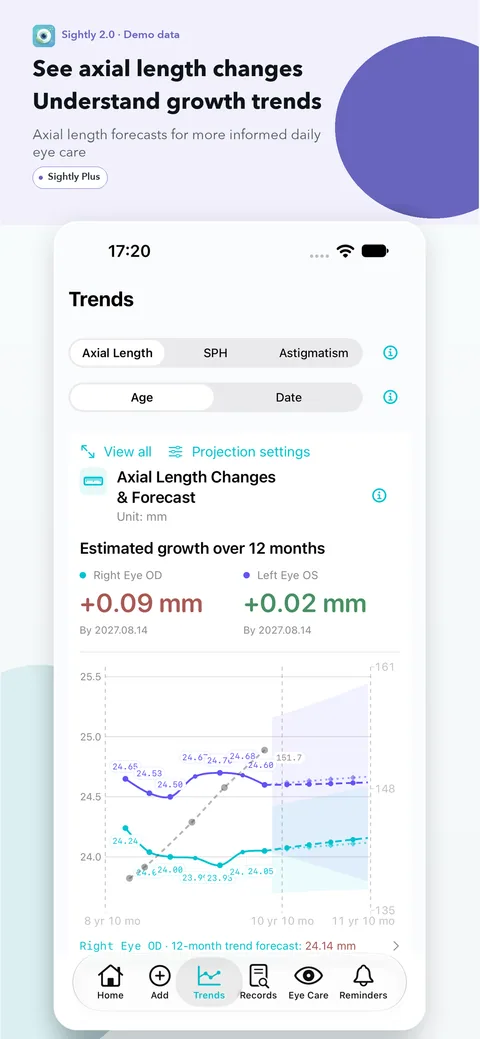
A line chart is easier to read than a stack of reports, but it is only as useful as the records behind it. Start by preserving the original measurements and their context. Your job as a record keeper is to make the history traceable, not to decide whether a change is medically significant.
These guides cover record keeping and appointment preparation, not diagnosis or treatment. Sightly does not assess medical risk or recommend treatment. Your clinician interprets examinations and decides care and follow-up timing.
1. Start with the report, not a target number
Find the axial length heading and the units on the original report. Keep the printed value for each eye in millimetres, including its displayed decimal precision. Do not estimate axial length from a glasses prescription or use a value copied from another child.
The International Myopia Institute’s 2025 Digest discusses monitoring refraction and axial length, where available, alongside ocular health assessment. A home record supports that conversation; it is not a substitute for the examination. IMI 2025 Digest.
2. Keep the exact exam date and eye labels
Record OD (right eye) and OS (left eye) separately. Use the examination date, even if you enter the data weeks later. If an eye was not measured, leave it blank. Do not average the two eyes into one value or connect one eye’s result to the other’s history.
If several printouts were produced during a visit and the final result is unclear, keep the originals and ask the clinic which result to use. Do not select the smallest number or average repeated readings yourself.
3. Preserve the conditions you actually know
Keep the clinic, device or method if it is stated, and any relevant clinician notes. If the clinic or measurement method changes, record that change; do not assume all readings are interchangeable. Missing information can stay unknown.
When refraction is measured at the same visit, keep its own values and cycloplegia status alongside the axial length record. Cycloplegia is context for refraction, not a reason to invent an adjusted axial length. Keep original signs and labels so your clinician can decide what can be compared.
4. Read the dates before comparing the numbers
A change over one month and a change over six months do not cover the same period. Keep the actual dates visible when reviewing a chart or preparing a summary. A long gap in the records is a gap in observations, not evidence that nothing changed.
Illustrative example only: a right-eye report dated January 12 lists 24.10 mm and another dated July 12 lists 24.18 mm. Your notes can retain both readings and both dates. Do not turn that example into a “normal” growth limit, an annual forecast or a treatment decision. If you show arithmetic differences, take the original reports as well.
5. Investigate unexpected entries before interpreting them
If a chart looks surprising, check for a reversed eye, wrong year, missing decimal point, incorrect unit or transcription error. Compare the entry with the original page before changing anything. A genuinely unusual measurement should remain documented and be discussed with the clinician.
Do not smooth the chart by deleting a measurement simply because it differs from nearby values. If the clinic corrects a result, retain the clarification in a note so the change remains understandable later. OCR can assist entry but cannot decide whether a measurement is clinically credible.
Quick checklist
- Exact examination dates are retained.
- OD and OS are separate; units are millimetres.
- No missing measurement has been filled with zero or an estimate.
- Available clinic, method and refraction conditions are noted.
- Unexpected entries have been checked against the originals.
- Questions about interpretation are saved for the clinician.
Using Sightly
You can save an axial-length-only examination in Sightly; every record does not need a complete set of tests. Record the measurements actually taken and check OCR against the original. Free use covers 1 child, 10 records and 1 photo per exam. Plus includes advanced trends and doctor PDF summaries. Keep original reports available even when you export a summary.
Download Sightly on the App StoreMedical context and sources
The IMI clinical summary supplies context on clinical monitoring. The example numbers are invented for filing practice and are not expected values, risk cut-offs or treatment targets.
Written by the Sightly Team, the app’s product team. Not a clinician-reviewed medical article.
These guides cover record keeping and appointment preparation, not diagnosis or treatment. Sightly does not assess medical risk or recommend treatment. Your clinician interprets examinations and decides care and follow-up timing.